© Luke Sevior 2026. This webpage and all attached images, writings and components have been produced by Luke Sevior//CVR. Exemptions exist for collaborative projects with designers, record labels and other creatives, all of whom are referenced under each project and have individually granted permission for inclusion on this webpage.

SOCIAL MEDIA IS SLOWLY LOSING IT'S GRIP ON THE UNDERGROUND MUSIC COMMUNITY
- Article by Luke Sevior. Published via lukecvr.com. 8/12/25
From its inception, dance music has always had to find creative ways to connect music to an audience. The audience within an underground context in is in fact a hyper specific collective of people who would continue to come together and connect with an artist or individual. The specificity of the dancer was for the protection of not only the people involved but also the longevity and continuation of the gathering. In the earliest days, David Mancuso held and maintained a detailed mailing list to post physical invitations for his infamous Loft parties. In Chicago at a similar time, dancers were given membership cards to access The Warehouse where Frankie Knuckles would become a legend of the underground genre and earn the nickname the ‘Godfather of House Music’. These practices formed a connected relationship between the DJ and the dancer. The dancer benefited from the safety and freedom to be themselves surrounded by regular and dedicated club goers while the DJ benefited from returning attendees without concern that any discriminatory or authoritarian figures would infiltrate the door and ruin the magic. It was a community, and it instilled a sense of trust and safety into club culture from the outset, which was critical especially in the 70’s which made dance floors a place for queer and black people in America.
In the modern age, promoters have been able to utilise social media tools to inform, promote & sell tickets to parties all in one online resource. It importantly can grow dance floors to new audiences exponentially in the modern and highly competitive club scene we see today. But as social media approaches 20 years of connection, larger concerns are growing about the ethics of a few platforms. From privacy concerns, mis information, censorship issues, ticket scamming and online harassment, it has left some promoters and activists turning their backs on social media, finding or creating new alternatives on their own. Some are even speaking out on the negative impact they believe it has on the underground dance scene. We investigate those few who are changing their views on platforms and those rare ones who have resisted these avenues all together.
This article is not designed to begin or accelerate any sort of debate against the multitude of parties and labels who utilise social media effectively. The truth is that social media is an essential part in the success of any band or musician today. As Shawn Reynaldo pointed out in his First Floor essay titled ‘The Rise Of The Avatar DJ’, we are “in a time where social media—and Instagram in particular—is at the centre of everything, an artist’s music has become almost secondary; it’s their persona that fans are most likely to connect with”. This is a very true assessment (for better or for worse) and it would be normal to imagine that most music listeners have a selection of artists that they keep up to date with on social media without necessarily listening or enjoying all their musical output. One might view this as beyond the point of the craft or that the effort of the music is overshadowed by an artist’s social media display but as Shawn puts it, “that’s where dance music is right now.”
Social media has undergone a major revolution in the past five years. In the period following the pandemic, an unprecedented level of saturation has instilled itself in the dance music scene. More bedroom made DJ’s and enthusiasts attempt to enter their local club and event circuits while promoters and venue owners are struggling to keep their doors open due to economic instability. There are now more people who yearn to be behind the DJ booth in some capacity than in the front row. As a result of these factors, DJ’s and promoters now have to contend with an industry that is now more competitive than ever and success financially in these spaces are generally (we will touch on some outliers) the ones who can adapt their marketing strategies and turn profits.
An outfit that may have missed the memo on this shift could include Audiojack’s James Rial and Richard Burkinshaw. The Leeds born DJ/producer duo have been touring across the globe over the past decade, performing at institutions like Fabric in London and Space in Ibiza where they are now based. Across two posts, they share that 2025 might be the last year of touring, citing “an inflated economy (has made) touring as a DJ duo almost impossible.” They speak at length about the cost challenges associated with travelling in a post Covid economy.
See blow Audiojack's full posts on Facebook.
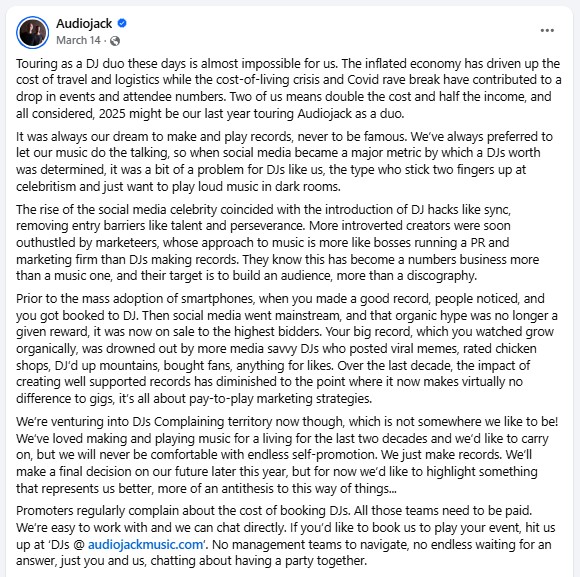
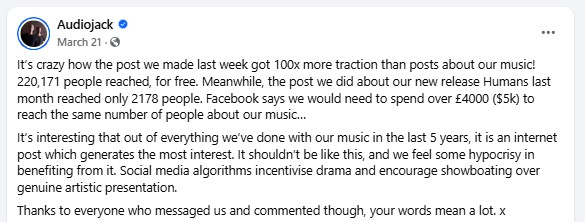
There are couple of valid points made by Audiojack and they do highlight some sad pathways the industry has gone down, but (to be harsh) though they try to avoid entering ‘complaining territory’ that is unfortunately how this post reads. What can be analysed is the divergence between mainstream and the underground appears to be wider and more transparent than ever before, and it seems Audiojack have left themselves somewhere in the middle. If they want to exist in the region of dance music where they are based in Ibiza¹ and make a sustainable income, resistance to adapt to the social media marketing or management teams probably isn’t going to help them.
( ¹ at time of writing, Audiojack have their RA page based in Ibiza. I suspect this is old information as they likely now reside back in the UK. If it is old, they certainly could help themselves by editing this)
According to Resident Advisor, Audiojack’s current Ibiza roster is lucky to see them perform two times per year on the Balearic Isle. Yes, this did peak higher in 2015 (a decade ago) during their Sunday Social events, contrast that against German tastemaker and Running Back head, Gerd Janson who has for the same period of time toured Ibiza almost half a dozen times yearly and maintains one of the busiest global schedules in the DJ world. Gerd Janson is known famously for not utilising any form and social media and he’s not alone either. Ricardo Villalobos, Helena Hauff, PLO Man & Hashman Deejay and DJ Sprinkles are some of the underground’s most revered and long-established DJ’s globally. There are also other acts like Tech House/Electro connoisseur Evan Baggs who hasn’t had an active social media presence since 2021 and continues moves strength to strength.
In 2022, Attack Magazine questioned DJ’s that have, like Gerd Janson, avoided social media through their careers including the aforementioned Helena Hauff. When asked if she had ever utilised platforms, she revealed that she “was on MySpace for two months in 2007… (she) didn’t like the way it made her feel” and “consumed too much of (her) time.” She conceded that she could be more famous if she utilised Facebook or Instagram but continued saying “anymore fame could compromise my sound… I’m in a happy medium place where I can do whatever I want and still make enough money to live a comfortable life.” As of writing this section of the article Helena for the remainder of 2025 is set to perform this coming Houghton Festival in the UK, her first tour of India in October as well as returning to Croatia for Dimensions Festival where she has performed every iteration since 2012.
The global discourse on social media’s effect in electronic music is as divisive as ever. Both sides of the argument have clear evidence of success, and nobody is wrong. In the end, the decision on which direction to take falls upon the artist. While one path may result in much faster success, the other, though much harder, can achieve a greater sense of accomplishment because the only way artists like Helena & Gerd have gotten to where they are is through music, and music alone. Artists need to know they have the decision to go either way, but hard work in both directions is the only way to get there. The wrong thing to do is to be stuck in the middle (like Audiojack) and throw mud artists for utilising the tools we have at our disposal in 2025.
Where judgement might be better directed is toward the promoters who view social media figures as an essential requirement. The decision to book one artist over another based only on follower figures is a lazy practice. Promoters need to be much more dynamic, put aside ego and open themselves to the people and activists who are attending their parties. Listen and communicate to the people trying to get their foot in the door. Respond to the DJ’s emailing or sending mixes in the DM’s and organise opportunities for smaller artists to shine.
On the global scale, it’s not just big-time touring DJ’s who have resisted social media avenues. There are a few domestic examples of this decision being the more long lasting approach. Meredith Music Festival is synonymous figure with the local Australian music scene. Floating under the surface of the indie music offering it’s a festival that seems to only appear on the radar of the attendees who have dedicated at least a couple of years attention to the independent music channels. Specific, but not exclusive listening of local Melbourne radio stations RRR and PBS will certainly inform you of it. Attending local gigs can connect you with likeminded regulars plus also the word-of-mouth conversation or generational family knowledge that gets music listeners in the know.
That is about the extent of many of people’s introduction to the festival. There’s the occasional poster stuck on the brick walls of the inner Melbourne laneways, but this alone wouldn’t convince anyone to invest without an additional influence from the above list. All this to say, Meredith has never held or utilised an official social media account to promote either its December event or its sister event Golden Plains which takes place in March. Both events harness a beautifully designed website which has continued to be built upon over the many decades of the festivals existence, including frequently asked questions, and now a new archival component reflecting on all of the past festivals since 1991.
Against the grain of downward spiralling festivals such as Blues Fest, Splendour In The Grass (and its parent company Secret Sounds which was also behind Falls Festival), Big Day Out, Party In The Paddock, Groovin The Moo, Boogie Festival and many more. Meredith has continued its steady yet consistent growth for almost 35 years and reliably sells all its tickets usually within a week of its balloting process. They also (and quite rightfully too) proudly advertise their tickets without any brand or commercial sponsorship which is very rare thing.
Though an attempt to email Aunty directly about why they choose to not use social media was not granted with an answer, they did congratulate the analysis that Meredith does indeed “use social media very selectively, almost not at all.” The only thing close that Meredith manages is a YouTube account titled ‘Home Videos’ which is populated with medium production video footage of past moments and bands.
It is quite a marvel to see such a healthy and widely loved event continue concurrently against the commentary of the Australian music industry’s nosediving position. While Meredith and Golden Plains ignore the necessity of a hyperactive social media account, it should be noted that its clear organisers are not in any way oblivious to it or its influence on their audience. For Meredith’s 2024 lineup, a surprise inclusion took the form of American rapper and vocalist Princess Superstar. A flourishing name for producers and labels throughout the 2000’s, her success peaked when Dutch electronic label Armand Music mashed together her tune ‘Perfect’ with Mason’s electro banger, ‘Exceeder.’ This mashup, peaked at number 3 in the UK pop singles chart of 2007. The single laid dormant for over sixteen years until its inclusion in the 2023 film ‘Saltburn,’ which shot the tune back into fame. Its modern reintroduction made waves across the internet particularly on the video sharing app Tik Tok. Currently the song (and its multitude of variations) has amassed over 100,000 uses on Tik Tok alone and ‘Perfect (Exceeder)’ reached gold status 17 years after the song was put together.
Performing live at the iconic Supernatural Amphitheatre, the Meredith crowd turned ballistic when Princess Superstars played the hit not just once, but twice during her short half-hour performance. It’s impressive that Meredith can keep its finger on the pulse of popular social media trends in this way and provides excitement for both younger and older audiences who use these platforms. Their absence from social media doesn’t mean they can still analyse what’s going on. From a punters perspective, it was a resounding success and while Meredith is not the only festival to wheel out artists for these sentimental throwback moments, they will undoubtedly be looking to ride that viral wave again to thrive for future years to come.
As Meredith continues to transcend the industries apparent dire position, there are also a selection of smaller collectives who are also switching to similar approaches. In the past year the sophomore iteration of small-scale festival, Moniker, took place once again in the remote forests of the Victorian Otway’s. In the lead up to their return, social media imagery in the form of unique calligraphy was uploaded, allowing followers to playfully decipher a code which connected to a custom-built website unveiling the dates, lineup and other specific information for the festival. The site also includes a freestyle blog feature designed to allow interested attendees to interact & swap or transfer tickets among other creative ideas. It generated its own, close looped, private social platform for punters attending. The website, though a little crude in its navigation, was clearly a much more arduous avenue for organisers to put together, but it allowed them to connect to their audience in a far more intimate and direct way. For anyone who understands how website backends are put together, it is usually a tedious process, even with the assistance of platforms like Square Space or WordPress. The dedication for Moniker organisers to create this platform for the only 300 people who attended is a clear demonstration of small collective’s interest to move away from Facebook or Instagram and to not rely so dominantly on them as they continue to drive themselves into more unethical practices.
Another example of an event crafting unique website alternatives; fellow Melbourne event group Diaga’s 2024 event ‘Door Code 104’ utilised an impressive old-school MS designed site to sell tickets to its one off the event in Coburg. The lineup included artists like OK EG, Tangela and Venus Flytrap. Diega has been a long running offshoot from music festival Tabula Rasa and is certainly a crowd favourite for small scale boutique dance offerings. The design agenda and unique ticketing avenues through website design is what makes Diega such an appeal to connect local punters with diverse international artists.
While the number of organisers who are working the extra effort to utilise these other mediums are relatively small; the effort has begun yielding more consistent success. Dance music has always been about sharing a unique and connected experience. If DJ’s want to create these special connections with the music they perform, they sure as well can produce a way to communicate to their communities in an equally unique way. Instagram and Facebook have for over a decade allowed people to share their experiences in photo form with friends, but it cannot be denied that the platform and its high rate of user ship have flattened everything. Parties and all their differentiating qualities begin to look similar. You can also easily track your favourite artists movements, making the opportunity to watch them appear less critical, which could factor into the trending rhythm of slow ticket sales. The opportunity to search and look for music has been simplified and the instantaneousness of music satisfaction have dulled away the beautiful moments.
Dance music, locally and globally, are in a really amazing position to begin to disconnect its dependency from the social media, particularly the Meta platforms and allow the scene stand up for itself and craft its own unique communication channels. It might be a new, more ethical social media platform, it might be multiple different methods, who knows what it will look like but the truth is the music needs to stand up for itself again. Resident Advisor so far is a really great example of an all-in-one event and ticketing platform. If promoters put time and effort moving away from social media and stepping back into developing artworks, email subscriptions and communicating more directly to its audience, it will only improve the vitality of the scene. They will be able to regain a uniqueness that is now lost. It won’t be easy, and the initial attendance results will slow but it will certainly create more beautiful and intimate moments for dancers and that is what it’s all about.
------------------
Post Script thoughts:
The seed of this article has been in development for over a year now, since my own dismissal of social media, I have wanted to construct a way to justify my position about it. Getting started as a DJ during the pandemic, the importance of social media at that point was crucial. It was extremely useful and it is still difficult to deny its ability to grow an audience and connect with likeminded music enthusiasts. However as I started to delve deeper into the scene, and try and craft my own identity with the music I play, I quickly became discontent with the way in which I would have to promote myself continuously and become a fake variant of my own self.
I decided if I wanted to do music, I would want to do it my way and in whatever way was comfortable. That was not in the form of advertising myself to me friends and peers, I wanted to create beautiful art and connect in more intimate ways to make the experience more meaningful.
These days, I feel far more creative thanks to my new website which I can alter and design in an infinite amount of ways to say what I need to communicate. I’ll be the first to admit that the community following and checking into this page is smaller than what I could theoretically achieve on the apps, but I find it aligns much closer with my comfort.
Thanks for reading my essay. If you would love to discuss any of the topics, either in support or disagreement with any of these points, please get in touch I would love to engage in discourse with you.
Corrections may be made and will be listed below.